
Interventions for FASD
What are interventions for FASD?
An intervention is a strategy we put in place to help meet a specific goal or to address a challenge. When we talk about services, support, and treatment for people with fetal alcohol spectrum disorder (FASD), we are talking about interventions. People with FASD often benefit from a range of support and interventions throughout their lives. These supports can help improve health, relationships, learning, and more, contributing to someone’s overall wellbeing and quality of life, and improving their ability to consistently access their strengths. Interventions may change over time as an individual grows and changes and as their needs and strengths evolve.
Why interventions are important
Each person with FASD is unique; they have their own strengths needs and goals. The interventions that will be most effective are the ones that take into consideration each person’s personal pattern of strength and challenge. With the right supports, individuals with FASD can achieve positive, healthy outcomes in many areas of their lives. To learn more about how supports can evolve across the lifespan, explore the Towards Healthy Outcomes framework or browse the resources below.
Areas of interventions
People with FASD may need supports across multiple areas of life. The categories below reflect key areas where FASD interventions and services can make a difference, as outlined in the Towards Healthy Outcomes framework.
-
- Physical Wellbeing – including nutrition, physical activity, physical health, and experiences in healthcare
- Attachment and Relationships – including early life adversity, trauma, and relationship skills
- Social Competency – including aggression, sexual behaviour
- Mental Wellness – including mental health, suicidality, substance use, therapeutic approaches
- Education and Skill Building – including school supports, learning, and skills
- Identity – including stigma and stereotypes, disability representation, race, class, gender, and sexual orientation, human rights
- Interdependence – including daily living, service delivery and support, transition periods ect.
- Employment – including resources for employees, employers, and those supporting employment
- Housing – including resources for individuals with FASD, families, FASD service providers and housing providers
- Parenting with FASD – including resources for individuals with FASD, families, FASD service providers
Additional resources and research
Some FASD interventions, supports, and services apply across multiple areas and may not fit into one specific category under the Towards Healthy Outcomes framework. You may find these below or in under our other research priorities.
Finding the right supports can make a meaningful difference. Be sure to check out the Towards Healthy Outcomes framework and explore our full range of FASD resources, tools, and research to learn more about interventions that can support healthy outcomes for people with FASD across the lifespan.
Towards Healthy Outcomes
Towards Healthy Outcomes 2.0 | Une vie saine pour les individus ayant le TSAF
Towards Healthy Outcomes (THO) is a framework that helps guide consistent, goal-oriented intervention planning across the lifespan. It gives us a shared language when talking about how to approach supports, services, and interventions for people fetal alcohol spectrum disorder (FASD).
The framework was developed through ongoing collaboration between researchers, service providers, and community partners. It is available for free to download in both French and English.
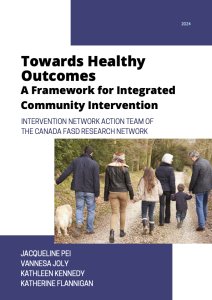
Core Tenets of the THO
Three underlying principles can be applied across all services, supports, and developmental opportunities as we work collectively to support healthy outcomes:
-
- A developmental lifespan perspective is necessary at all ages and stages,
- Interactive systems and environments have additive and ongoing influences on the individual,
- We need to be goal-oriented in our approaches – focusing on desired outcomes, and embodying an empowered and strengths-based approach that engages individuals with FASD and identified caregivers
Ten Domains of FASD Intervention and Support
The THO framework is organized into ten different domains that are important to consider throughout someone’s lifespan: physical wellbeing, attachment & relationship, social competency, mental wellness, education and skill building, identity, interdependence, employment, housing, and parenting. These domains are not distinct, and will interact with each other, but are separated here to highlight important developmental contributions to healthy outcomes. Each domain in the THO has a section to help you learn, understand, and enact the information provided.
Related Research
Towards healthy outcomes for individuals with FASD: a philosophy and approach to intervention (open access)
Vannesa Joly, Kelly Harding, Jacqueline Pei
Journal of Fetal Alcohol Spectrum Disorder, September 2022
Related Resources
Towards Healthy Outcomes 2.0: Framework Updates and Policy Implementations (webinar)
CanFASD, March 2024
FASD Supports and Service Providers
Delivering services and supports for people with FASD and their families can be challenging. Coordinated care and support across Canada is inconsistent and underfunded, creating structural boundaries for individuals who benefit from integrated and responsive intervention strategies. But organizations throughout the country are doing an incredible job supporting people with FASD, despite limited resources and funding. Below you can find research and resources related to service delivery and FASD.
Integrated service delivery for individuals with fetal alcohol spectrum disorder (2023)
Individuals with disabilities and their families experience diverse needs that often necessitate supports from a wide range of systems. Integrated service delivery – person-centred coordination and linkage of health, social, and/or community services to meet client needs – presents a potential model for enhancing support for people with a range of complex needs and disabilities, including those with fetal alcohol spectrum disorder.
An Integrative Systems Approach to Enhancing Service Delivery for Individuals with Complex Needs (2021)
In this literature scan, researchers present findings to guide service delivery for individuals and families affected by FASD and other complex needs. They explore four overarching guiding principles for policy decision-makers, seven guiding practices for organizations, and 23 guiding practices for service providers.
Best Practices for Serving Individuals with Complex Needs (2018)
This guide is meant to support individuals and agencies working with clients with a Fetal Alcohol Spectrum Disorder (FASD) and their families. It outlines how agencies and their staff can assess current service delivery and inform future service offerings.
The FASD Patient Journey (2018)
In September 2018, the Alberta FASD Cross Ministry Committee initiated an FASD Patient Journey Project to examine the current state of FASD services and supports from the perspective of persons with FASD, their caregivers and their service providers. After 120 interviews in 34 communities across Alberta, the project team has captured not only their perspectives on service delivery but their frustrations, ideas, hopes and dreams as well.
Neuropsychological Aspects of Prevention and Intervention for FASD in Canada (2016)
With quality cross-sectoral research and evaluation that incorporates the living experiences of parents and individuals with FASD, it will be possible to enhance understanding of facilitators and barriers to service delivery with respect to FASD prevention and intervention in Canada.
Parents, Caregivers, and Families
Caring for someone with FASD comes with unique challenges and successes. Being a caregiver is an immensely rewarding experience experience, but it is also very demanding. Whether you are a foster parent, birth parent, or guardian, finding the right supports and resources for you and your family is essential – at every stage in your caregiving journey. Below is a selection of research and resources related to supporting someone with FASD, including key information, treatment and interventions for caregivers and families. You can find more on our information for families page.
Resources
Supporting Caregivers through Acceptance and Commitment Therapy (2021)
This video is a recording of a webinar from the CanFASD 2021 Dr. Sterling Clarren FASD Research Award Winner, Dr. Brianne Redquest. She speaks about her research delivering Acceptance and Commitment Therapy (ACT) to support the wellbeing of caregivers of individuals with FASD across Ontario. Results showed that these workshops led to a significant reduction in stress, improvements in psychological wellbeing, and caregivers feeling supported and valued.
Caregiver Needs and Stress in Caring for Individuals with Fetal Alcohol Spectrum Disorder: Lay Summary (2015)
There is little research on the needs of caregivers supporting individuals with FASD and associations with caregiver stress. In this study, researchers examined: 1) the needs of those caring for individuals with FASD, 2) whether their needs are met, and 3) whether caregiver stress is associated with these needs and other caregiver/child characteristics.
Issue Papers
FASD and Siblings: A Review of Current Knowledge (2026)
Siblings of individuals with FASD are underrepresented in FASD research. Relationships between siblings are extremely meaningful and offer developmental opportunities; at the same time, siblings of individuals with FASD may experience risk of parentification, sibling separation, similar adverse childhood experiences, and lower parental attention. This issue paper explores research related to siblings of people with FASD.