
People with Fetal Alcohol Spectrum Disorder (FASD) are overrepresented in the child welfare system, both in Canada and internationally. However, most children with FASD are not formally diagnosed, particularly when they enter the system. Child welfare workers are more likely than any other human service professional to encounter FASD, yet many don’t have the tools they need to help. Those who work in the child welfare system should have a strong understanding of FASD, including the needs and challenges, and the ways in which to foster strengths and improve outcomes.
Key Resources and Reports
Issue Paper: FASD and Child Welfare
January 2020, CanFASD Research Network
Children, youth, and young adults with FASD are a key population in the child welfare system. Social workers and other professionals who work in the system need more education, training, and support to address the needs of individuals with FASD and their families.
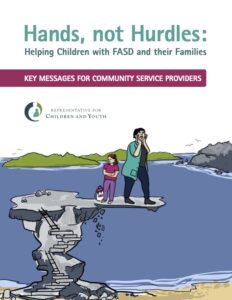
Hands, not Hurdles: Helping Children with FASD and their Families
September 2022, Representative for Children and Youth
The lack of understanding about the complexities of FASD leads to blaming, shaming, stigma, discrimination and racism that causes harm to people with FASD and their families. This short report illustrates key takeaways community service providers should understand when helping children with FASD.
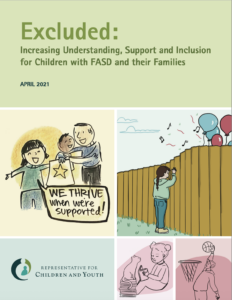
Excluded: Increasing Understanding, Support and Inclusion for Children with FASD and their Families
April 2021, Representative for Children & Youth
This report pushes for the provincial government in British Columbia to take both immediate and long-term action to improve supports and services to children with fetal alcohol spectrum disorder (FASD) and their families.
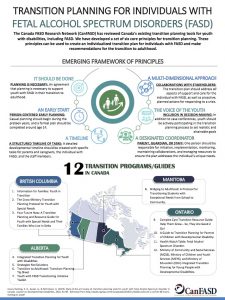
Transition Planning for Individuals with FASD
Journal on Developmental Disabilities, 2019
CanFASD looked at Canada’s existing transition planning tools for youth with disabilities, including FASD, and came up with a set of six core principles for transition planning. These principles can be used to make an individualized transition plan for a youth with FASD and make recommendations for their transition to adulthood.
Key Research Articles
These select journal articles, authored by members of the CanFASD Research Network and partners, showcase key research related to FASD and the child welfare system:
Aboriginal Kinship Carers and Children with FASD in Western Australia: Advancing Knowledge from an Indigenous Disability Lens
Robyn Williams & Dorothy Badry
First People Child & Family Review, 2023
Examining barriers to harm reduction and child welfare services for pregnant women and mothers who use substances using a stigma action framework
Lindsay Wolfson, Rose A. Schmidt, Julie Stinson & Nancy Poole
Health Social Care in the Community, February 2021
Advancing Knowledge on Best Practice and Care of Infants, Children, and Youth with Prenatal Substance Exposure/FASD in Child Welfare: Brief Summary
Dorothy Badry & Lenora Marcellus
June 2020
State-of-the-Art Review of Transition Planning Tools for Youth With FASD in Canada
Kelly Coons-Harding, Anna Azulai & Audrey McFarlane
Journal on Developmental Disabilities, 2019
Care of Children and Youth with Prenatal Substance Exposure in Child Welfare: A Scoping Literature Review of Best Practices
Canada FASD Research Network, 2018