

Fetal Alcohol Spectrum Disorder Identification, Assessment and Diagnosis Hub:
Canada’s Evidence-Based Portal for Identification, Diagnosis and Referral
Resources for Individuals with FASD, Families and Advocates
Welcome to the Identification, Assessment and Diagnosis Hub for Prenatal Alcohol Exposure and FASD (IAD Hub).
This side of the IAD Hub was made to give individuals with FASD, their families and advocates the tools and education they need to thrive. While reading and watching videos will not give you all of the answers you may be looking for, we aim to point you in the right direction—wherever you happen to be on your FASD learning journey.
Learn about alcohol use during pregnancy and how you can reach out for support.
Learn about getting referrals, what screening processes might be like, and the benefits of seeking early diagnosis.
Preconception and Pregnancy
Are you thinking about pregnancy?
Learn more about Fetal Alcohol Spectrum Disorder in English or French
or click here to reflect on your alcohol use.
What do we know about alcohol in general?
Alcohol use is one of the most widely used and socially accepted substances across the globe.
1. There are risks from any amount of alcohol use.
There are no known protective effects from drinking alcohol, even at low amounts: there are risks of alcohol use no matter who is drinking, and how much is being drank.
Even though moderate, occasional, and low levels of alcohol use are sometimes described as ‘responsible’ or ‘safe’, these levels are still associated with negative health outcomes, such as cancer, violence, familial disruption and diabetes. The same goes for types of alcohol—beer, wine and spirits all contain ethanol, which is the part that harms our health.
Learn more with Canada’s Guidance on alcohol and health. (English | French.) The takeaway from these guidelines? Drinking less benefits everyone.
2. Alcohol use impacts mental and physical health.
We sometimes use alcohol for stress relief, as it can mask anxiety, depression, or other emotions we might be feeling.
However, alcohol can disrupt sleep, affect relationships and—in the long run—make your stress, anxiety and depression worse.
Knowing Your Limits with Alcohol (English). A resource if you are looking to learn how to assess your drinking.
Going Forward: An Alcohol Use Reduction Tool. (English). A tool that helps people reduce their alcohol use over six weeks.
3. Sex and gender can change how alcohol can affect you.
Alcohol affects women more negatively than males; women experience higher blood alcohol levels and faster intoxication. As a result, women also tend to experience worse negative health effects when compared to men after drinking less alcohol.
However, the effects of alcohol are also dependent on many other things, such as the amount of food in your stomach, how often you drink, your age, and organ function.
Women and Alcohol Info Sheet. (English | French). 2023. An info sheet with general information relevant to alcohol, pregnancy, breastfeeding, parenting, and other factors about women’s health.
What Both Sexes and All Genders Need to Know About Lower Risk Drinking. (English). (2025). An article describing how alcohol affects and is affected by sex and gender.
What do we know about alcohol use during pregnancy?
It is safest not to use any alcohol during pregnancy.
There is no amount of alcohol that has been proven safe to consume during pregnancy. Alcohol use during pregnancy can increase risk of premature birth, miscarriage, and Fetal Alcohol Spectrum Disorder (FASD).
FASD is a lifelong disability. Since alcohol spreads through the system, it impacts brains and bodies while the fetus is developing. That means that no matter what stage of pregnancy alcohol is consumed, alcohol may have an effect.Since we are all different, the way our brains and bodies grow is also different. This is why FASD looks different from person to person: the ways that alcohol affects our development is unique to us. Read more about FASD in Considering Diagnosis.
Why might girls and women drink alcohol during pregnancy?
Women and girls may consume alcohol during pregnancy for a number of reasons:
1. They might not know they are pregnant.
Around 50% of pregnancies are unplanned. If you’re pregnant, planning a pregnancy, or at risk for an unplanned pregnancy, the safest option is to go alcohol-free.
2. They might not know how alcohol can affect a fetus.
Alcohol affects everyone differently, and this can make it confusing for many of us to know exactly what will happen. Not having a definitive answer can make the possibilities feel blurry and unknown.
3. They may underestimate the harms of alcohol use during pregnancy due to knowing other pregnant women who have drank alcohol during their pregnancies.
The effects of alcohol on a fetus can be hidden to many of us, or only apparent later in life.
4. Alcohol use might be the norm in their social group.
Consider that the sentence “let’s go drinking” implies alcohol use without ever having to say it. Alcohol use can be an important part of women’s lives, leading to exclusion and isolation if they stop using alcohol.
5. Alcohol use may be a coping mechanism.
Women may be using alcohol to cope with difficult situations, such as domestic violence, poverty, trauma, and isolation.
6. They may be struggling with alcohol addiction.
Many women stop drinking when they learn they are pregnant, but this is not a possibility for everyone. In some cases, harm reduction approaches can be the best and safest option.
It takes two to become pregnant: partners can play an important role in assisting women and girls with reducing or stopping alcohol use.
Read more about alcohol use, pregnancy, and how to help in these fact sheets: Why do Girls and Women Drink Alcohol During Pregnancy? (English.)
What if I am struggling to stop drinking?
Every step is important progress. Start by drinking less often, and having less drinks at any one time. You could alternate alcoholic drinks with water, or try making a mocktail.
Your health is more than alcohol use. Nutrition is an important part of a healthy pregnancy; eat a variety of foods, drink plenty of water, take multivitamins and get plenty of rest and sleep. Read more about nutrition and substance use (English | French).
Reducing alcohol use is not a streak to be broken. It is better thought of as a skill that needs time, effort, and practice.
I want to help someone I know. What can I do?
Learning more about alcohol use and pregnancy can be a great start. Knowing how to provide support and actively listen can be a great benefit to a future parent who is looking for answers.
The greatest barrier to seeking help for substance use, and especially alcohol use during pregnancy, is stigma. Mothers fear they will face blame, shame and judgment when they come looking for help. You can make a difference by offering solutions and support when they need them. Some strategies are:
- Celebrate and support every step. Recovery is not a streak that gets “broken”: recovery is a skill to be trained with practice and time.
- Offer alcohol-free outings for people who are pregnant or are trying for pregnancy. Where can you meet your friends where those that cannot drink will not feel excluded? If alcohol is being consumed, mocktails can offer a fun way to participate without consuming alcohol.
- Reduce or quit your own alcohol use to help create more substance-free spaces.
- If quitting alcohol use is not an option, reduction may be the best way forward.
Considering Diagnosis
FASD is a lifelong disability that affects the brains and bodies of individuals exposed to alcohol in the womb. Individuals with FASD can receive one of two diagnoses:
- FASD with facial features
- FASD without facial features
Less than 10% of individuals with FASD have facial features; that means that for the vast majority of people with FASD, their disability is not immediately obvious. While some signs in infants and young children may include low birth weight, developmental delays, and behavioural challenges, the lack of visible signs of FASD mean that FASD is often not diagnosed until later in life.
People with FASD will experience some degree of challenges in their daily living, meaning they may need support with parts of life like motor skills, learning, memory and emotional regulation. However, every person with FASD has strengths.
(English, auto-generated French subtitles available.)
See more experiences of people with FASD.
(English, auto-generated French subtitles available.)
Why should I consider diagnosis?
Learn from Reinier deSmit, an adult with FASD:
(English, auto-generated French subtitles available.)
Diagnosis is essential for getting people with FASD the support that they need. That includes interventions in education, employment, housing, mental health and more. Getting a diagnosis early in life is associated with less poor outcomes later in life, but as Reinier describes, diagnosis at any age can be greatly beneficial.
Everyone’s brain functions differently, and our surrounding environments are often not built to support these differences. Having a diagnosis can teach us how to rebuild our surroundings to support our differences.
Diagnosis can help identify a person’s strengths and challenges—it helps people understand themselves, and change their expectations to be meaningful and suitable for them. People with FASD often express relief after diagnosis because they finally have answers.
A diagnosis of FASD does not change who a person is. If you are considering FASD for yourself or your child, know that assessment will put you on the right path towards understanding and support.
What else should I know about getting a diagnosis of FASD?
1. Diagnosis can happen at any age.
Getting a diagnosis as an infant is possible, but can be more difficult. Experts recommend getting a diagnosis as soon as possible, as the earlier the understanding and supports are in place, the more the person’s challenges can be accounted for. More and more, people are also being diagnosed in adulthood, finding relief in better understanding themselves and a way forward in knowing where to find others that understand them, too.
Discovering FASD Later in Life: Understanding and Embracing a Late Diagnosis. (English, auto-generated French subtitles available).
Nancy Lockwood interviews Reinier deSmit about receiving an FASD diagnosis at the age of 56 in this webinar recording.
2. There are diagnostic clinics all over Canada.
Diagnosis of FASD can be a long and frustrating process, particularly if you don’t know where to look. Every year, CanFASD updates a list of diagnostic clinics across Canada, so you can find the closest place to you.
3. Diagnosis is a team process.
A multidisciplinary team is recommended to diagnose FASD, which can include a pediatrician/physician with expertise in FASD, a psychologist, speech-language pathologist, and occupational therapist. Supports and caregivers are empowered and encouraged to participate in the process wherever possible, too.
If I am a caregiver, how can I set up the person I support for success?
Getting a diagnosis as early as possible means you can start learning about and finding the right supports for your child. Diagnosis will set you on the right path towards support by identifying your child’s challenges and strengths.
(English, auto-generated French subtitles available.)
As you are moving forward, here are some other steps you can take.
Make a plan for getting a diagnosis.
What is your path to diagnosis? Many people are referred by health care providers or other services—some clinics also accept caregiver and self-referral. Some clinics also only accept certain age ranges, and others may have different criteria for whom they accept. Look at the diagnostic clinics near you.
- Find out: Which clinic is the best fit for you?
- Who do they accept?
- How do they accept them?
- What information will they need from you?
- Next steps: Reach out to a diagnostic clinic. Even if you are not on the right track, they will be able to point you in the right direction.
-
Make a plan for after diagnosis.
Whether your child is diagnosed with FASD or not, you will learn more about your child’s strengths and challenges. You may be pointed in the right direction for supports and possible other diagnoses. Work with your diagnostic team to make a plan for after the assessment. Ask them: what should my next steps be?
- Find out: What should my next steps be?
- What are my child’s strengths? How can we support them?
- What are my child’s challenges? What supports can be put in place where they need them?
- How can I summarize what my child needs to quickly convey that to others?
- Next steps: Work with your diagnostic clinic to find out what information needs to be passed on to others. Consider crafting an information letter for teachers
Learn to advocate.
You know the person you care for. Advocacy means knowing how to tell others what they need and how they need it done—and pushing against systems until they are FASD-informed.
This might mean:
- Being able to summarize your child’s challenges, and give concrete next steps on what could be done to accommodate them.
- Making a list of places that will need specific accommodations. To reduce having the same conversations over and over again, you could create a handout or information sheet about your child.
- Teaching people about FASD. Despite how common FASD is, many people do not know about the disorder or how to accommodate people who have it. You may have to answer questions about FASD, and encourage people to educate themselves.
Teach Self-Advocacy.
Teach your child to advocate for themselves. This is a skillset that will only benefit them.
Guides such as the Downloadable Self-Advocate Guide (English) can support you by helping your child conceptualize and map out their strengths, boost their confidence and create a script for advocacy.
Consider:
- Teaching them how to appropriately describe their abilities, needs, and the adaptations that help them thrive.
- Working with them to set their own SMART goals (Specific, Measureable, Achievable, Realistic, Time-related), choices and plans.
- Providing specific feedback to help them understand how they learn and think
- Encouraging them to talk about what they are thinking and rephrase their ideas to clarify what they need. Model this process by describing your own thoughts, as well.
- Letting them see you advocate. Modelling advocacy helps children learn how to advocate for themselves as well.
- Helping them prepare for meetings or other opportunities for advocacy. Role-playing can be a good tool for rehearsing these types of conversations.
Practice Self-Care.
Advocacy can be exhausting and frustrating at times. Your stress influences your health and wellbeing—taking care of yourself is essential to care for others.
- Find out: What is your form of self-care?
- Everyone navigates life differently, including the things that bring us joy and ground us. For some ideas, you can read Self-Care Strategies for Caregivers of People with FASD (English).
- Consider:
- When you have previously felt overwhelmed or exhausted, what brought you out of that space?
- Caregivers have remarkable strength and resilience. How often do you acknowledge that? Do you speak positively to yourself?
- Has the way you care for yourself changed throughout your life?
- How can you model self-care in a way that teaches your child to care for themselves?
Learn more about FASD and being a caregiver.
What Parents and Caregivers Need to Know About FASD. (English). A Manitoba-based booklet for parents and caregivers of children with FASD with information about FASD and possible strategies to help them live their best life possible.
All about FASD: A guide for adoptive and permanency families. (English). A British Columbia-based resource with an overview of FASD, the process of diagnosis, and overview of the process from a specific diagnostic clinic.
Adopting: Do You Know About (FASD)? (English).
This article describes experiences of families who adopted individuals with FASD.
KnowFASD. (English).
An interactive website that provides information about FASD across the spectrum and lifespan.
How do I make a plan for diagnosis?
1. Find the clinic that is the best fit for you.
CanFASD updates their list of diagnostic clinics across Canada annually.
- Find out: Who does that clinic see? Many clinics have different criteria for who they assess, such as only assessing adults or children, needing pre-tests that are already completed, or coming with knowledge of prenatal alcohol use.
-
2. The best way to find out more about the diagnostic process in your area is to find a clinic and reach out.
Many clinics can also provide guidance on how to approach conversations about referral or the assessment process; these clinics are well-versed in these types of discussions.
- Find out: Does the clinic accept self-referrals, or do you need to be referred by a health care provider or other service?
- Find out: What does your clinic need from you? Preparing your documents beforehand can help make the process easier and faster. You can also find out what you can bring to help you or your family during the assessment, as it can be a long and intensive process.
Find out strategies to simplify your medical journey. (English.)
Help individuals with FASD effectively communicate with medical professionals. (English).
3. If you are put on a wait list, ask what progress you can make while you are waiting.
- Find out: What services or education can you seek out in the meantime?
- Find out: Will you be in contact with the diagnostic clinic while you are waiting?
- Find out: Can you be put in touch with caregiver support groups or peer mentorship networks to begin building community?
During Diagnosis
In Canada, assessments for Fetal Alcohol Spectrum Disorder (FASD) follow national guidelines. This means it is completed by a specialized team of medical professionals, and includes assessment of:
- Specific facial features associated with FASD
- 10 brain assessment areas
You will be supported throughout the diagnostic process by the diagnostic team.
What else should I know about the diagnostic process?
It is a thorough process.
This means you may have multiple appointments that take place over several days or weeks.
Appointments may take place at multiple places.
You may be visiting different specialists for different assessments.
Clinics use an FASD Clinic coordinator.
This coordinator reviews referrals, helps prepare you for assessment, and helps you schedule your appointments. As part of that relationship, you should keep the coordinator informed of any changes in your personal information or decision to proceed.
You will get to know your results.
Clinics provide you a paper copy of the assessments and recommendations based on the diagnostic results, regardless of if a diagnosis of FASD is given.
Many clinics operate differently depending on who they assess, but a general overview of the process is available in the following graphic.
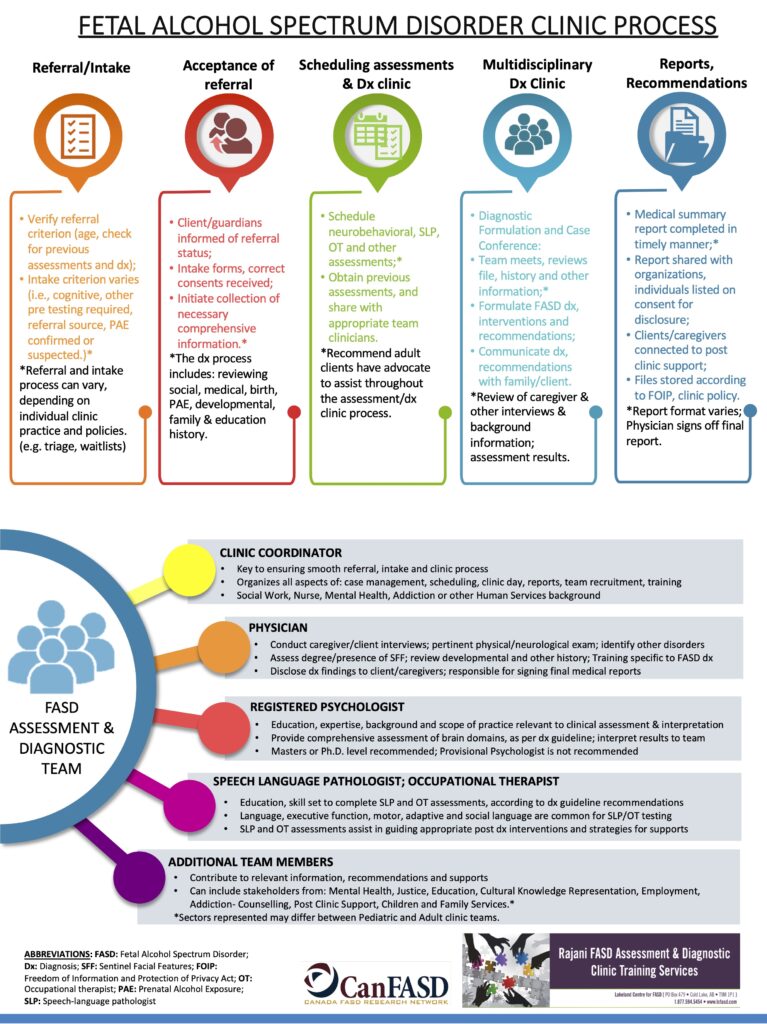
Preparing for the assessment process may involve explaining FASD to your child. Here are some guides that can help you with introducing this topic:
- How to explain an FASD Diagnosis to your Child. (English). Tips to explain an FASD diagnosis to your child to help them understand and be empowered.
- Talking to Your Child about FASD. (English, auto-generated subtitles available in French). A video walking through several experiences of caregivers and individuals with FASD.
There are also children’s books about FASD available about FASD, which may help in introducing the topic to younger children.
- What is Your Superpower?: Growing and Glowing with FASD. (English). This children’s book celebrates the power of love, support, and personal growth as children with FASD showcase their unique strengths. 100% of proceeds are being donated to the Canada FASD Research Network.
- OYM and the Moonlit Adventure. (English). This children’s friendship picture book showcases OYM’s journey, reminding us all that we belong, just as we are.
- La petite âme qui voulait absolument aller sur la terre. (French). A tale written by a caregiver of an individual with FASD about their journey to earth.
- This is me. (English). A tool about learning about FASD, featuring the character “Me”. Learn more about Me’s strengths, challenges, friends and strategies they use.
After Diagnosis
What Happens After Diagnosis of Fetal Alcohol Spectrum Disorder (FASD)?
You will receive a report that is written by the assessment team. This report will have:
- The diagnosis
- Recommendations for support
- A description of the person’s strengths and challenges
Receiving a diagnosis of FASD may feel overwhelming. You may also be relieved. Feeling emotion in response to a diagnosis is a common and normal experience: an important part of accepting yourself is letting these emotions come to you and trying to understand them.
Reading more and watching videos might help you come to understand the way you feel and how you can move forward.
The best way to learn is from the people with FASD themselves.
Learn more from the experts: Lived and Living Experience
FASD Success. (English). Join Jeff Noble, a former foster parent and Global FASD Educator, on his podcast as he interviews caregivers, individuals with FASD, and researchers about all things FASD.
Shining Through. (English). An 18 minute film following two middle school students in British Columbia.
FASD Makes Me, Me. (English, auto-generated French subtitles available). This film was co-developed with individuals with FASD and their families, and features the life of a boy named Charlie. Charlie is voiced by Conar, a 13 year old with FASD.
Discovering FASD Later in Life: Understanding and Embracing a Late Diagnosis. (English, auto-generated French subtitles available). Nancy Lockwood interviews Reinier deSmit about receiving an FASD diagnosis at the age of 56 in this webinar recording.
FASD: A Whole-Body Diagnosis. (English, auto-generated French subtitles available). Join individual with FASD, motivational speaker and advocate Myles Himmelreich as he leads a webinar about his experiences, and what we know about FASD.
FASD & Educational Accommodations. (English, auto-generated French subtitles available). (2022). A 10 minute video led by children with FASD, educating about FASD and their experiences in school.
Vivre avec le Trouble du spectre de l’alcoolisation fœtale. Témoignage de Guillaume et Marc-André. (French, auto-generated English subtitles available). A video exploring the life of Guillaume, a person with FASD, and his father Marc-André.
Next steps: The Now What? Question
If you are looking for next steps, you have come to the right place. Seeking out education and learning all that you can is a great next step in becoming FASD-informed and learning how to advocate for yourself or for others.
You can begin by finding more information on the Information For Families, Information for Individuals with FASD, and Lifespan Intervention pages.
If you are ready to dive into some resources, you can start with the below. Many of these resources are comprehensive—some are more bite-sized than others. Pick that education that best suits your needs.

(Quick links to websites that you can explore at your leisure).
(Less than 5 page documents; less than 5 minute videos)
(50+ page documents and 10+ minute videos)
Ways to Get Involved:
The Family Advisory Committee (FAC). This group of committed parents and caregivers of individuals with FASD work with CanFASD to improve the quality of life for individuals with FASD and their caregivers.
The Adult FASD Expert Collaboration Team (AFECT). This group of adults with FASD make sure the voices of living experience are being heard in CanFASD research! AFECT meets monthly.
Organizing FASD Family/Caregiver Support Groups Facilitator’s Guide. (English | French). (2021). Interested in starting or facilitating your own FASD support groups? This manual for service providers and FASD caregivers can help get you started.
Lived Experience Leadership Fund. This donation-based fund covers the cost for people with lived and living experience to participate in research activities. Learn more and donate.
The Canada FASD Conference. Every two years, CanFASD organizes a conference in a different part of Canada. This conference brings together people with living experience, policy makers and researchers; we welcome people from all backgrounds to share our knowledge of FASD.
Specific Topics
Parenting an Individual with FASD
If you are parenting someone with FASD, rest assured that you are not alone! Caregivers all over Canada have worked hard to share their advice and experiences to help others in the FASD community. Here are a few resources that can help you in your learning journey.
Learning to Advocate
Advocacy can be one of the most challenging, and yet most essential, skills for an individual with FASD and their caregivers to develop. Advocacy can mean many things, including knowing how to summarize FASD (and knowing how to summarize your needs and strengths). Some resources to help build this skill are below.
Trauma Responses and Building Safety
Individuals with FASD experience brain-based and environmental challenges throughout their lives. However, PAE can disrupt the way the brain responds to stress, meaning people with FASD may be more sensitive to stress.
This brain-based vulnerability is compounded by the adversities that individuals with FASD experience, such as abuse, neglect, and environments that are unsupportive for them. By learning about FASD and trauma, you can help create the safe and supportive environment that can act as a protective factor against negative outcomes.
Routine, Structure, and Setting Goals
When it comes to successful strategies, every person with FASD is different. Not all strategies will work for the same person. For example, some individuals benefit from breaking down goals into tiny steps, but some do not. When applying these strategies, it is always important to search for what works best for you or the individual you support.
Transition Planning
FASD is lifelong. As people with FASD age, their needs and strengths may change—as will the environment’s expectations of them. Individuals with FASD can be supported in and prepared for their life transitions, whether it be going from school to employment, one home to another, or aging out of supportive services.
Social Skills
Our social skills can deeply influence our overall wellbeing. However, people with FASD may have unique challenges when navigating social situations; they may have difficulty understanding their own feelings, social cues or abstract concepts, like object ownership. Here are some resources to get started learning how to nurture social skills for individuals with FASD.
Memory and Attention
Individuals with FASD may have difficulty with their memory or attention. They may need reminders to complete a task, get distracted partway through an instruction, or need to be re-taught something when in a new environment. These brain differences are complex and unique; they will be different for every person with FASD. Here are some strategies to help get you started.
Sleep
The rest we get from sleep and our brain’s functioning are intimately connected. Sleep problems (like insomnia, night terrors, or waking up early) are relatively common in people with FASD, which can then impact other brain and body functions during the day, like impulsivity or emotional regulation. Learn more about what we know about FASD and sleep below.
Behaviour and Emotional Regulation
All behaviour is functional. There is an underlying intent or want that drives us to act, even if that want isn’t immediately clear. Behaviours that appear disruptive can actually be a person with FASD regulating a sensory input, communicating that they feel overwhelmed, or regaining a sense of control. Learn more about the connection between behaviour, emotion and function below.
Cognition
People with FASD have differences in the way their brains are structured: that means the way they think might be different too. Cognition includes a lot of things all at once, some of which we might take for granted, like being able to remember and organize a long list of daily tasks. Our brains are complicated, and the way we think will be unique to us. This is true for people with FASD, too.
Language and Communication
Language and communication can be a challenge for people with FASD, whether it be being able to answer questions, stay on topic, or understand what is being said to them.
Individuals with FASD may also appear to be lying, when in reality their brain is confabulating. Confabulation occurs when the brain unconsciously takes pieces of information from the day and connects them into a new memory. Consider a time where you and another person have remembered the same event differently: both of you considered your memories to be “true”. For individuals with FASD, their memories feel real and true, too.
Education and Teaching
School can be a challenge for many people with FASD. This is an area of life where much is demanded of a developing brain. We know that with the proper supports, children with FASD can thrive in the school system. There are many resources built for teachers and educators about understanding and supporting individuals with FASD. You can find some of them below.

Workplace Resources
Employment is another area where individuals with FASD can benefit greatly from understanding and support. Though individuals with FASD may have difficulties with executive functioning (which includes aspects like following instructions, organizing and staying focused), supportive environments put strategies in place to help them succeed. Something as simple as labelled cabinets can act as a support.
Like other areas of life, the strategies that work for someone with FASD in the workplace will be unique to them. Below are some resources to get you started.
Sensory Sensitivities
When we experience sensory inputs, like smells and noises, our brain has to work to make sense of them. Individuals with FASD may have difficulty with organizing this sensory information, leading them to experiencing painful sensory overload or being unable to feel pain in some circumstances.
Housing
Individuals with FASD have the fundamental human right to safe and stable housing. However, getting and keeping housing can be uniquely demanding for someone with brain differences when the right supports are not in place.
CanFASD has developed a website regarding FASD and housing.
Learn more at Co-Creating Housing Solutions: Enacting Opportunities for Individuals with FASD.
Nutrition
FASD is a disorder of the brain and body. That means that for some people, digestion and ability to absorb nutrients may be altered in individuals with FASD. People with FASD may also have difficulty feeling hungry, thirsty, or full when they have eaten. This can make maintaining proper nutrition difficult, but we know that people feel, think and emotionally regulate better when they eat and drink well.
Sexuality, Gender Expression and Sexual Orientation
Difficulties with impulsivity or understanding social cues can impact the sexual health of individuals with FASD. At the same time, sexuality, sexual health, gender expression and sexual orientation are rich and diverse parts of many peoples’ lives.
Many resources can be found on the CanFASD page for Sexuality. Further resources can be found below.
Travel
Travel is an experience of many changes and sensory inputs. This may be a challenging experience for someone with FASD.
Financial Help
The Disability Tax Credit (DTC) is a non-refundable tax credit that helps people with prolonged disabilities or their supporting persons reduce the amount of income tax they may have to pay.
Self-Care & Asking for Help
Self-care is an essential skill to develop, both for caregivers and individuals with FASD. Self-care does not need to be expensive or time-consuming, and it will look different for everyone. Here are some resources to help you find what works for you.