This blog was written by Emily Weckend.
When I first began working with my supervisor Dr Melissa Tremblay on a project about co-creating an Indigenous FASD Framework in Canada, I felt completely out of my depth. Not only was I new to the world of FASD (Fetal Alcohol Spectrum Disorder) research, I am also a settler with German and Chinese ancestry. How could I understand the challenges that Indigenous Peoples face when it comes to accessing FASD services and healthcare?
I had the honour of participating in advisory circle meetings for the project where a group of Indigenous women and allies from across Canada shared important teachings and knowledge and FASD, regional healthcare issues, and Indigenous health and wellness. Through this process, I began to learn more and more about what sets Indigenous perspectives towards FASD apart from Euro-Western ones.
It’s important to remember that Indigenous Peoples are incredibly diverse. Each community, Nation, and group have their own unique beliefs, practices, laws, and customs. However, I began to notice an idea that was echoed by many of our advisory committee members and community members that our team interviewed. Every child is a gift. What a beautiful idea: every child is a gift. This was repeated, sometimes in different words, by Indigenous Elders, community members and advisory circle members from across provinces and territories. This means that every child with FASD is also a gift.
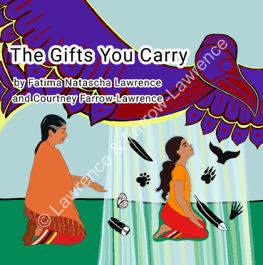
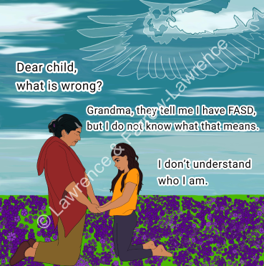


The Gifts You Carry: A Story of a Sacred Child and Fetal Alcohol Spectrum Disorder, by Fatima Natascha Lawrence and Courtney Farrow-Lawrence, illustrated by Courtney Farrow-Lawrence & Alissa Foley (2025)
As described by Courtney Farrow-Lawrence and Fatima Natscha Lawrence in their book The Gifts You Carry, illustrated with Alissa Foley, children with FASD have special virtues that contribute to their communities, like strength, love, expressiveness and determination. However, sometimes these virtues may make it challenging for children to complete certain tasks or may increase the risk of certain situations if they get distracted or become carried away. As such, it is also extremely important for families and communities to support children with FASD in both nurturing their gifts, and helping them manage the difficulties that may come their way.

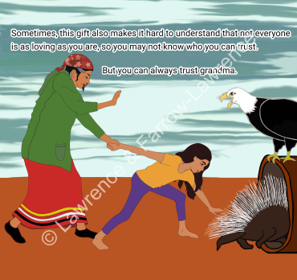


The Gifts You Carry: A Story of a Sacred Child and Fetal Alcohol Spectrum Disorder, by Fatima Natascha Lawrence and Courtney Farrow-Lawrence, illustrated by Courtney Farrow-Lawrence & Alissa Foley (2025)
This beautiful teaching made me think of my own Chinese culture. My mother was born in Macau, a Portuguese colony south of China. She raised me with the same belief that children are gifts. When we were little, she gave me and my brother red envelopes (利是) on the Lunar New Year to give us luck and protect us from evil spirits. She also taught us that children are special blessings from heaven. In fact, my baby cousin was given the name 天恩, which can roughly be translated as “heavenly grace” or “blessing of heaven.”
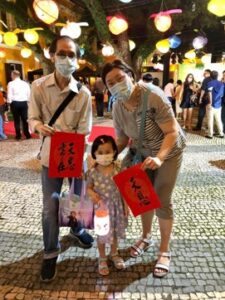

My cousin, 天恩 – blessing of/from heaven
Family and community are also deeply important in Chinese culture. If you go to most Chinese restaurants, you might notice that it’s not just couples eating together, like in fancy Western restaurants. Instead, you often see young children, parents, grandparents, and sometimes great-grandparents dining at the same table. Similar to many Indigenous cultures, grandparents play a special role in taking care of children. There is a famous proverb, 四世同堂, or ‘Four Generations Under One Roof’ which refers to an ideal of multiple generations living harmoniously together and supporting one another in a shared home.
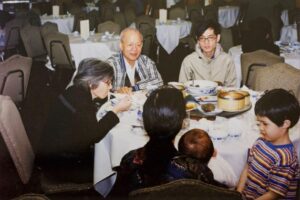

My family (grandparents, parents, uncles, brother and me as a baby) eating dim sum together.
These similarities made me think about how Indigenous teachings might connect with those of other ethnic and cultural communities in Canada. Not just in FASD healthcare provision, but in society as a whole. It also makes me consider how intercultural allyship can be harnessed in decolonization efforts and initiatives that support individuals with FASD.
Immigrants, refugees, and People of Colour also have important responsibilities when it comes to advocating for Indigenous rights as guests on the treaty territories of Turtle Island. Fighting against racism, discrimination and for decolonization benefits our society as a whole. Not only are many Indigenous ways of knowing and beliefs compatible with those belonging to ethnic and cultural minorities in Canada, they offer new possibilities for just, mutual care and support. Imagine if communities and families felt an obligation to nurture the gifts and talents of each child with FASD. What if we all recognized that we have a responsibility to support one another? To reduce harm for those who face more challenges? And in turn, that support would be there for us when we encounter challenges?
As a settler with German and Chinese heritage, I still have a lot of work to do when it comes to learning about FASD, and Indigenous health and wellness. Part of that learning is actively supporting decolonization efforts in healthcare and FASD research. I encourage readers engaged in allyship initiatives to consider the following resources in a call to continue supporting decolonization in FASD healthcare provision and research from regions across Canada:
- Piruqatigiit Resource Centre, a “nonprofit organization located in Iqaluit, Nunavut providing evidence-based, Inuit guided education, support and programming for Nunavummiut with FASD/other neurodiversities and their families across the lifespan.” The link includes free courses regarding FASD and Nunavummiut communities.
- The Unforgotten, a “five-part film exploring the health and well-being of Indigenous peoples living in Canada” from the Canadian Medical Association
- Indigenous Ally Toolkit from UBC
- The Unlearning Club, Public Health Sudbury